Add your promotional text...

Why RTT Errors Still Occur – Even in Well-Run Trusts
May 2026
5/27/20262 min read
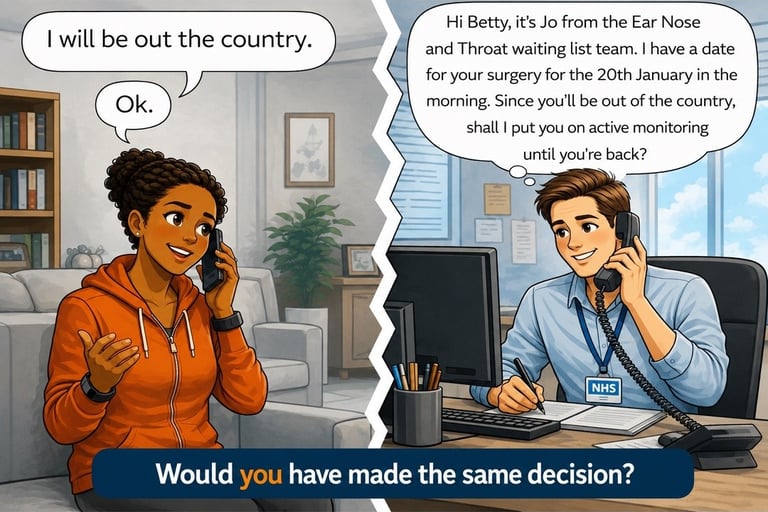
A simple scenario…
Was the way Jo processed Betty’s pathway correct?
From an NHS England RTT guidance perspective, based on this scenario alone, Jo’s actions would be considered incorrect for a number of reasons.
And yet, from experience — this type of situation happens regularly across many hospitals.
The bigger question
In many NHS organisations, significant effort is invested in maintaining accurate RTT pathways. Dedicated teams, regular audits, and established processes are all in place.
1. RTT is complex — and constantly changing
RTT guidance is detailed, nuanced, and often open to interpretation in real-world scenarios.
Staff are not just following rules — they are:
interpreting RTT guidelines
interpreting clinic letters
making judgement calls
working across multiple systems
So why do RTT errors still occur — even in well-run Trusts?
Even experienced staff can make errors, especially when pathways are non-linear or outcomes are unclear
2. Errors happen at the point of decision-making
RTT errors don’t just happen because staff haven’t been trained. They also happen in the moment a decision is made.
For example:
• Should this pathway be stopped?
• Is this active monitoring?
• Has the correct RTT status been applied?
These decisions are often made quickly, under pressure, and without immediate feedback.
3. Training alone does not guarantee compliance
Many Trusts invest in RTT training.
But:
• knowledge fades over time
• training isn’t always scenario-based
• real-world complexity isn’t always reflected
This creates a gap between what staff know and what they do.
4. System changes increase risk
With the rollout of EPR systems such as Cerner and Epic, workflows are evolving.
While these systems bring benefits, they also:
• introduce new processes
• increase reliance on correct system input
• create variation during transition periods
This can increase the risk of RTT errors.
5. The impact goes beyond data
RTT errors are not just data issues.
They lead to:
• increased reliance on validation teams
• time spent correcting records
• reduced confidence in reporting
• compliance risks
And as highlighted in my previous blog, they can also affect patient confidence and trust.
A different approach: try giving some focus on decision-making
To reduce RTT errors effectively, why not give attention to - not just more training — but better support at the point of decision-making.
This means:
• reinforcing learning through real-world scenarios
• making training accessible and continuous
• providing immediate feedback
• embedding understanding into everyday workflows
Conclusion
RTT errors persist not because Trusts are failing, but because the environment is complex and fast-paced. Improvement comes from supporting staff to make the right decisions — consistently.
Final thought
Improving RTT compliance isn’t just about more training. It’s about making the right decisions, in real-world situations, every day.

Contact
Questions? Here to help.
hello@therttpeople.com
© 2026. All rights reserved.